

This post is dedicated to anyone who has suffered from body shame.
When I was a teenager, I suffered from body dysmorphic disorder. I spent hours in front of a mirror daily, analyzing and hating my appearance. Almost all my facial features looked ugly, and I thought about having cosmetic surgery to change them. I actually had one: double eyelid surgery.
After the surgery, I was doubly ashamed. The surgery did not change my sense of ugliness, and now I also felt fake. I became even more anxious around people, worrying that they might find out about my surgery. It was a taboo to have cosmetic surgery in my country (not so much a taboo anymore, which does not address the root problem). The culture shames people for being born with certain appearances but also shames them for altering them to match its beauty standards.
My country (Japan) and East Asia in general are obsessed with double eyelids. This is because the looks of Western people have been considered beauty ideals in these countries, and what distinguishes East Asians from Western people the most is the size and shape of their eyes (see Kowner, 2004, for a related discussion).1 Most celebrities in Japan have double eyelids (many of whom are Asian/White),2 and teenagers typically learn what is beautiful and ugly by looking at the appearances of celebrities. So I was sometimes rejected by girls I liked in high school because I did not have double eyelids. After high school I moved to the West and felt somewhat relieved because people there seemed to care less about eye shapes. (They seemed to care more about body shapes than about facial features.)

At age 20 I shifted my focus to becoming intelligent and started to care less about my physical appearance. But my sense of ugliness did not disappear completely until awakening. There was, however, an event prior to awakening that significantly eased my sense of ugliness. It was when I revealed my surgery to my ex-girlfriend. She responded, “It is nothing. Why are you ashamed of such a thing? You are beautiful whether you had the operation or not,” and kissed my eyelids. After she left the room, I cried. It was the first time in my life I accepted my appearance.
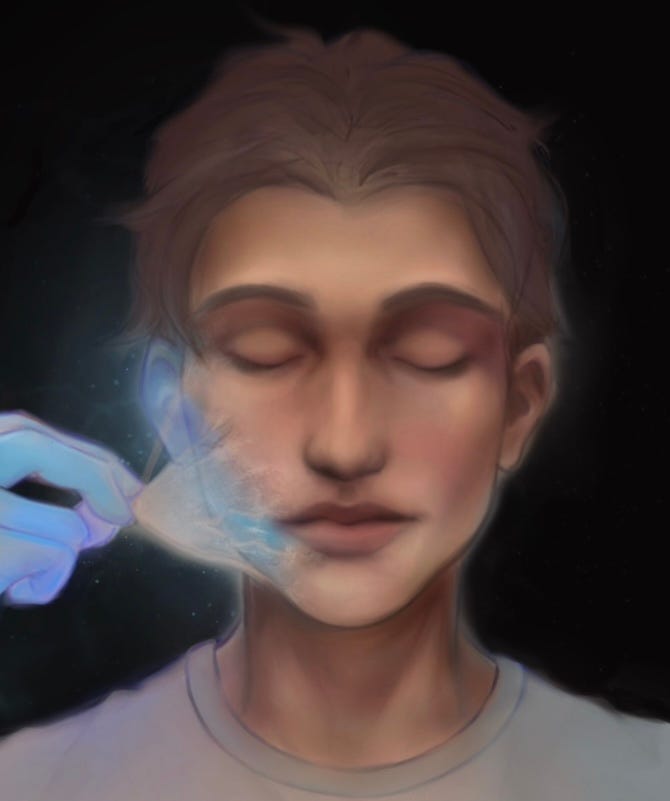
When I watched the movie American Beauty for the first time, it touched me deeply. But I did not know why. Now I do. It was pointing to Beauty beyond the duality of beauty and ugliness: immanent beauty that is revealed when the veils of social conventions and existential biases are lifted.3
There is no one who really benefits from beauty standards. If you think people who match beauty standards are lucky, think again. We often hear conventionally attractive people complain that people care about nothing but their appearance. Indeed, these people, especially if they are women, are often viewed and treated as sexual objects.
So, what is true beauty? It is the inner luminosity that is present in and shared by everyone. It does not belong to particular individuals. But for most people, this luminosity is buried deep due to social and existential fears. It is revealed on rare occasions when unconditional love is felt. When you were a kid, you loved your mother and father not because they were good-looking but because you saw their radiant love. And this radiant love and beauty is what we are all seeking, not superficial beauty.4
Beauty standards will keep changing.5 They are arbitrary. So you are wasting your time if you think you can secure permanent beauty by chasing them. True, essential beauty is timeless. It never changes and is ever-present. It only needs to be uncovered. To see it requires not better eyesight but a deeper state of consciousness.
May we see the inherent beauty that has never been lost and that is in each of us. May the world be a place where there is no beauty standard and no cosmetic surgery. May the world feel unconditional love and be free of shame. May all shine with radiant love and beauty.
References
Kowner, R. (2004). When ideals are too "far off": Physical self-ideal discrepancy and body dissatisfaction in Japan. Genetic, Social, and General Psychology Monographs, 130(4), 333–361. https://doi.org/10.3200/MONO.130.4.333-364
Before Westernization, Japan’s perception of beauty was very different. For example, take a look at the drawing Three Beauties of the Present Day (1793). These women would be considered ugly by today’s Japanese beauty standards.
It is probably one of the selection criteria in the Japanese entertainment industry. I heard people with talent but without double eyelids were often persuaded to have cosmetic surgery.
The veil of social conventions is seen through before that of more fundamental, existential biases, which is only seen through in awakening. Each step deepens psychological or spiritual liberation. I’ll talk about this developmental process in another post.
I am not saying appearance is valueless; I am saying appearance can truly glow when radiant love shines through it.
During the past decade, there have been attempts to make the appearances of previously discriminated races beauty standards. But such attempts merely perpetuate racism (from white supremacy to white shame). We cannot solve racism while being obsessed with race. Racism can be solved only when the concept of race becomes irrelevant.
This article of yours appeared in my inbox. For some reason not all substacks I subscribe to notify me of new articles, and it looks like yours is no exception. But this item slipped through.
I read this wise meditation on beauty and loved every word. And I've looked over the rest of your writing just now and it resonates strongly and cleanly with my passions and interests.
Whatever "awakening" is, it appears I'm entering that territory, in a pretty messy, incoherent and nebulous manner. I have no idea what I'm doing, but I'm trying to find out.
So, from someone who doesn't know you from a bar of soap, keep thinking, feeling and writing, it's lucid, valuable and insightful.