
Two Phases of Nondual Realization: Why Spiritual Escapism May Be Inevitable


Last month I created a thread on an online forum to meet people who are familiar with nonduality in my area. The people I have met so far shared a common struggle: They understood the nondual nature of reality but struggled with the phenomenal world. Here are some of the things they told me (they were in Japanese, so I have translated them into English):
“While I’m outside the matrix, I’m totally happy and peaceful. But as soon as I come back to this [the matrix], I suffer. This difference is too painful to bear.”
“I’ve been wanting to meet people I can talk about nonduality with, but now I am entering a narrative and hate it!”
“I’m aware of the nondual nature of reality, but this awareness paradoxically makes life difficult. I experience intense conflict.”
“Nonduality has saved me, but at the same time it doesn’t save me at all. I struggle with this paradox immensely.”
This kind of experience is common. In fact, it seems to be a phase that everyone on the spiritual path goes through. In this phase, people understand that reality is nondual, but this understanding conflicts with their perception of the world. Since this initial nondual realization is accompanied by a profound sense of peace (i.e., the oneness experience), it often becomes their escape. They often disengage from the phenomenal world—particularly the social world—to maintain the sense of peace (e.g., meditating all day, avoiding people).
Again, this seems to be a necessary phase on the spiritual path. We operate under the illusion of the ego and separation for decades (in a society that shares the illusion); therefore, extended periods of solitude and meditation would be necessary to stabilize a nondual perspective and break that illusion. However, if a person keeps avoiding the phenomenal world, the discrepancy between their nondual worldview and their perception of the world remains, which leads them to reject and despise the world.
Phase 1: Form Is Emptiness (The Many Is the One)
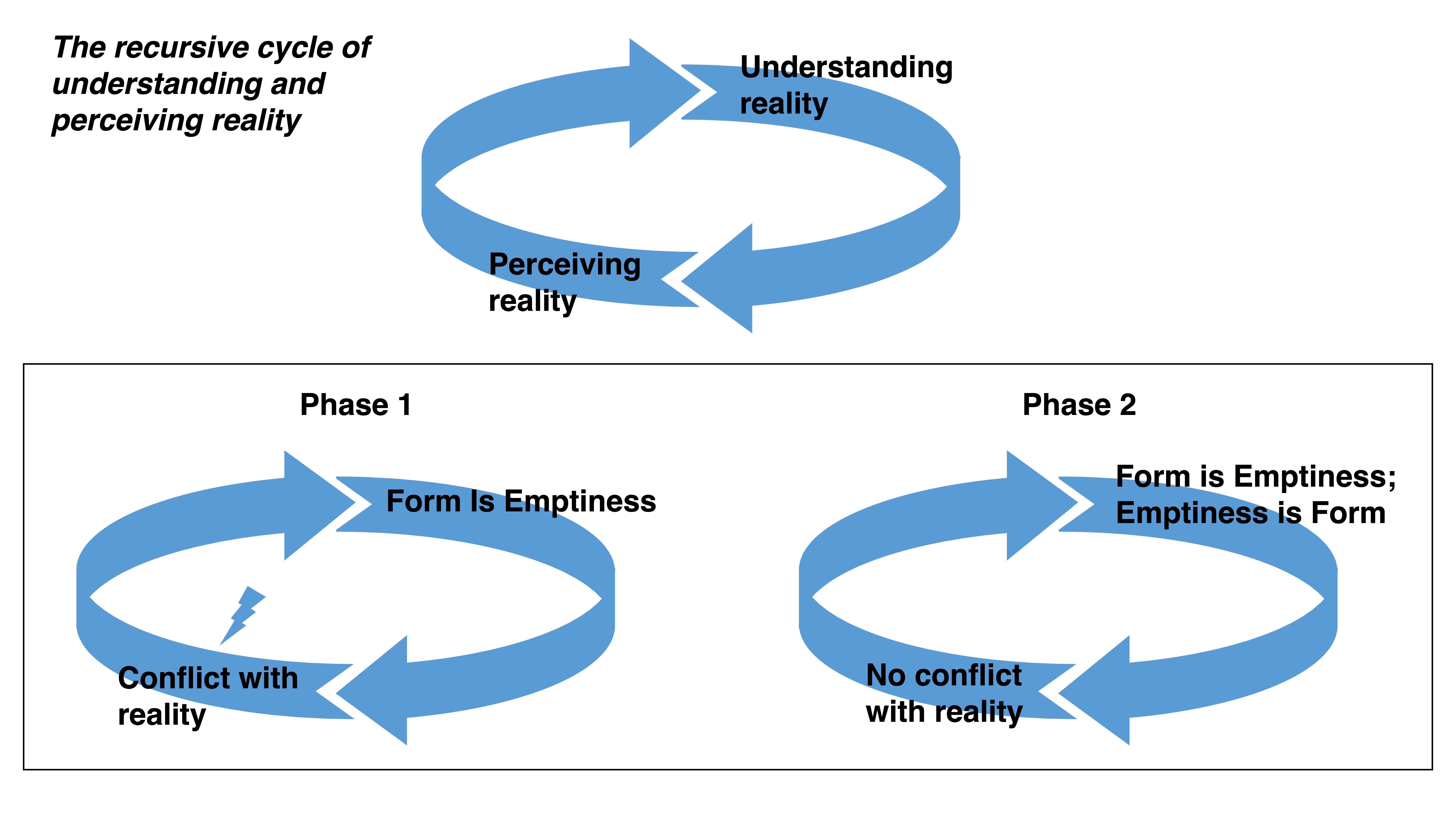
When people first see through the illusion of separation and realize that no phenomenon has inherent existence—no phenomenon exists on its own—they often reject phenomena as illusory. However, since such rejection cannot make the perception of phenomena disappear, which are apparently differentiated, a conflict arises between their nondual worldview and their perception of phenomena. They have not yet understood how Emptiness can be Form or the One can be the Many (see Figure 1).
Figure 1
The Recursive Cycle of Understanding and Perceiving Reality: Two Phases of Nondual Realization
Phase 2: Emptiness Is Form (The One Is the Many)
Phase 1 is what people typically mean by nondual realization. But nonduality also means that duality and nonduality are not two. It is not just that Form is Emptiness or the Many is the One but that Emptiness is Form or the One is the Many. This is considered complete nondual realization (Wilber, 2000). In Phase 1, duality was transcended but not included.
As people meet the phenomenal world with a nondual perspective again and again despite the discomfort, they begin to see that phenomena are not separate from the empty Ground or Source and that the empty Ground or Source manifests as phenomena. When this ultimate nondual realization happens, the perception of phenomena no longer triggers dissonance and conflict. You see differences but also the underlying unity. You stop avoiding phenomena and fully engage as phenomena. You begin to move and live seamlessly as the empty Ground, as Phenomena.
References
Wilber, K. (2000). Sex, ecology, and spirituality: The spirit of evolution (2nd ed.). Shambhala.
Sometimes the early stage of awakening rejects the world.
But deeper realization often brings a different movement
life is no longer something to escape, but something awareness flows through naturally.